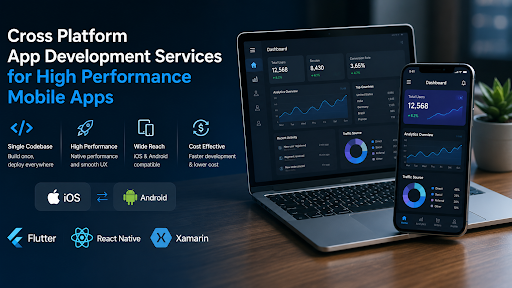
The performance question follows cross-platform development around like a rumor that refuses to die. Ask any native iOS or Android developer what they think of Flutter or React Native and you’ll usually get some version of “it’s fine for simple apps.” The implication being that the moment anything gets complicated, the framework buckles and you wish you’d built natively. That reputation was earned, partly, in the early days of cross-platform mobile development. It has not kept up with where the frameworks actually are in 2026.
Businesses choosing cross platform app development service for genuinely complex, performance-sensitive applications are no longer making a compromise. They’re making a considered technical decision with a clear set of trade-offs, and for a large majority of commercial mobile applications, those trade-offs land in favor of cross-platform. Here’s what the performance picture actually looks like now and where the real considerations sit.
What “Performance” Actually Means in Practice
Performance in a mobile app covers several distinct things that often get conflated. Frame rate, how smoothly the UI renders during animations and transitions. Load time, how quickly the app starts and screens appear. Battery usage, how efficiently the app consumes power during active use and background operation. Memory usage, how the app manages RAM, particularly on lower-end devices. Network efficiency, how well the app handles requests, caching, and offline scenarios.
Native development has historically had theoretical advantages in all of these categories. In practice, most of those advantages only materialize in applications pushing the boundaries of what mobile hardware can do, graphics-intensive games, real-time augmented reality experiences, and applications requiring deep continuous hardware integration. For a business app, a marketplace, a logistics tool, a fitness platform, a healthcare product, a fintech application, the performance ceiling is rarely reached using a well-built cross-platform approach.
The more common performance problems in real-world mobile apps have nothing to do with the framework choice. They come from inefficient database queries, poorly managed network requests, unoptimized image assets, and state management that triggers unnecessary UI rebuilds. These problems occur in native codebases just as readily as cross-platform ones, and solving them requires the same diagnostic approach regardless of what framework the app was built in.
Flutter’s Rendering Architecture
Flutter’s performance characteristics come from an architectural choice that distinguishes it from frameworks like React Native. Rather than translating UI components to native platform widgets, Flutter uses its own rendering engine, Skia on older devices and Impeller on newer ones, to draw every pixel of the UI directly on the canvas. This means Flutter bypasses the JavaScript bridge that was the primary performance bottleneck in early versions of React Native.
The consequence is frame rendering performance that is consistently close to native, with 60fps sustained on mid-range devices and 120fps on devices with high-refresh displays, for standard UI patterns. The Flutter DevTools profiler gives developers visibility into frame timings, widget rebuild counts, and shader compilation events at a granularity that makes performance problems diagnosable and fixable rather than mysterious.
Impeller, Flutter’s newer rendering backend, specifically addresses shader compilation jitter, the brief frame drops that occurred in previous versions when a new UI effect was rendered for the first time. This was one of the clearest perceptible performance differences between Flutter and native development, and Impeller largely eliminates it for applications targeting current iOS and Android versions.
React Native’s New Architecture
React Native went through a significant architectural overhaul with the introduction of the New Architecture, which became stable in React Native 0.73 and is the default in current versions. The two key components are JSI (JavaScript Interface), which replaces the asynchronous bridge between JavaScript and native code with a synchronous interface that eliminates bridge overhead, and Fabric, the new rendering system that handles UI operations synchronously with the JavaScript thread.
The practical effect of these changes is that performance-sensitive operations that previously required workarounds or native modules can now be handled within React Native itself with performance characteristics close to native. Animations using the Reanimated 3 library, which runs on the UI thread rather than the JavaScript thread, produce 60fps animations that are perceptibly indistinguishable from native equivalents in most use cases.
Turbo Modules, the third pillar of the New Architecture, allow native module access to be lazy-loaded and called synchronously, which reduces startup time and eliminates a category of performance issue that affected heavier React Native applications in previous versions.
Where the Real Performance Ceiling Sits
The honest answer about where cross-platform reaches its limits is fairly narrow. Complex 3D rendering, continuous real-time AR experiences using ARKit or ARCore, and applications requiring sustained use of specialized hardware APIs at maximum throughput are areas where native still has practical advantages. These represent a small fraction of commercial mobile applications.
For anything involving standard UI patterns, data visualization, maps integration, camera functionality, biometric authentication, push notifications, and background processing, a well-architected Flutter or React Native application delivers performance that end users cannot distinguish from native. The distinction exists in benchmarks. It doesn’t consistently exist in the experience of someone using the app.
This is where the decision to build a cross-platform mobile app becomes commercially sensible rather than technically compromised. The performance is there for the use case. The shared codebase reduces development time and ongoing maintenance cost. The single team with shared context makes architectural decisions more consistent and iteration faster.
Profiling and Optimization in Practice
High performance in a cross-platform application doesn’t happen automatically from framework selection. It comes from active profiling and optimization during development. Flutter DevTools provides the widget rebuild inspector that shows which parts of the UI are re-rendering unnecessarily, the memory profiler that tracks allocation and garbage collection, and the performance overlay that shows frame timings in real time during development.
React Native’s Flipper integration provides equivalent capability: the Hermes profiler for JavaScript execution analysis, the network inspector for API call timing, and the layout inspector for understanding render tree structure. Using these tools actively during development rather than as post-launch debugging instruments is the difference between an app that performs well at launch and one that requires optimization work after users start complaining.
Common optimization patterns apply regardless of framework: lazy loading for lists of dynamic content using virtual list implementations, image caching and compression to reduce memory pressure, memoization to prevent unnecessary recalculation of derived data, and proper use of background isolates in Flutter or web workers in React Native for computationally expensive operations that shouldn’t block the UI thread.
What This Means for the Build Decision
The performance conversation should happen during the scoping phase of any mobile project, with the specific use case and its specific performance requirements as the starting point rather than an abstract debate about frameworks. A business building a standard commercial application, the vast majority of the market, can confidently choose a cross-platform approach and invest the cost and timeline savings in better design, more thorough testing, or additional features rather than framework performance that users won’t perceive.
The businesses that should seriously evaluate native development are the ones building applications where the specific technical requirements push against the real limits of cross-platform rendering, and those requirements should be identifiable from the product specification rather than assumed from general skepticism about the approach.
Most applications aren’t building those requirements. Most businesses will ship a better product on a better timeline at lower cost by choosing cross-platform and spending the difference on things that actually affect user experience.












+ There are no comments
Add yours