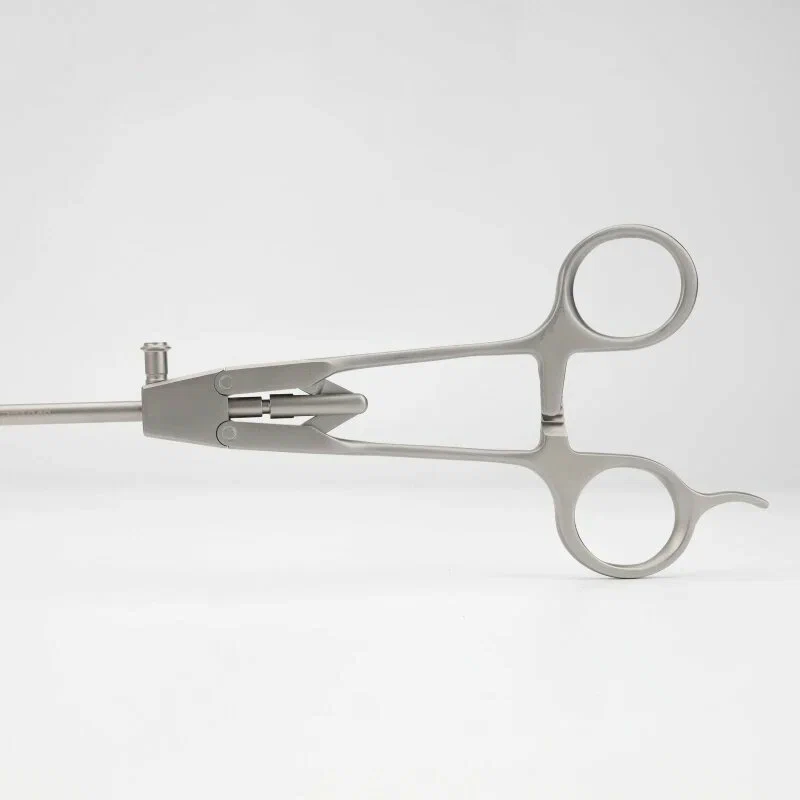
Suturing during minimally invasive surgery requires controlled movement, a stable grip, and enough space to position the needle accurately. A laparoscopic needle holder helps surgeons manipulate a suture needle through small access points, but its shape can influence how easily it reaches the target area. Straight and curved designs serve the same essential purpose, yet each offers practical advantages depending on the surgical site, approach angle, and available working space.
The Role of Needle Holders in Laparoscopic Suturing
Laparoscopic procedures use a camera and long instruments inserted through small incisions. Because surgeons view the operative field on a monitor, instrument control and visual coordination are particularly important. A needle holder must secure the needle firmly while allowing deliberate movements through tissue without frequent repositioning.
The jaws, handle, shaft, and locking mechanism all influence performance. Jaw alignment affects needle stability, while handle design contributes to comfort and control. The appropriate instrument also depends on the surgeon’s technique, the location of the suture, and the requirements of the procedure.
-
Needle Grip and Jaw Alignment
The jaws should hold the needle securely without making repositioning difficult. Proper alignment helps maintain a consistent angle as the needle enters and exits tissue. An uneven grip may allow the needle to rotate, interrupting the movement and requiring adjustment.
-
Handle Control and Locking Mechanisms
Handle design influences how naturally the instrument responds to the surgeon’s hand. A ratchet or locking mechanism can maintain the needle’s grip when engaged, reducing the need for constant pressure. Smooth operation matters because stiff movement or an unreliable lock can complicate precise suturing.
-
Shaft Length and Reach
The shaft must provide access to the operative area while allowing controlled movement outside the patient. Reach requirements vary with anatomy, port placement, and procedure type. A suitable length supports access without making the instrument awkward to maneuver.
-
Material and Repeated Sterilization
Surgical instruments must withstand cleaning and sterilization according to the manufacturer’s instructions. Medical-grade stainless steel is commonly used for its strength and corrosion resistance. Regular inspection for wear, surface damage, jaw alignment, and smooth locking action helps identify potential problems before reuse.
-
Coordination with Other Instruments
Suturing often involves graspers, scissors, dissectors, and other tools. The team should consider how these instruments share limited space and whether their movement paths allow the needle to be positioned without unnecessary contact or obstruction.
Straight Needle Holders: Direct Access and Familiar Movement
A straight needle holder offers a direct working profile that can be useful when the suture site is accessible along a relatively clear path. Its shape may feel intuitive to surgeons familiar with straight instruments, particularly when the needle can be positioned without a sharp change in direction. The choice still depends on port placement, anatomy, and the intended approach.
This design can support suturing where the instrument has enough room to align its jaws and rotate the needle as required. However, a straight profile is not automatically suitable for every accessible site. Surgeons must consider the viewing angle, tissue position, and available working space before choosing the instrument.
Curved Needle Holders: Angled Access in Restricted Spaces
A curved needle holder provides an alternative when the target lies at an angle or within a deeper, narrower working area. Its profile may help position the jaws around the needle while navigating obstacles created by nearby anatomy or other instruments. This can be useful when a straight approach would require awkward repositioning.
Curvature does not guarantee easier suturing in every situation. The instrument must still align with the needle and the intended direction of passage, while the surgeon maintains clear visual feedback. Familiarity with its shape is important because orientation affects how the jaws approach the needle and how the shaft moves within the operative field.
Practical Factors When Comparing Designs
The choice between straight and curved holders should be based on the task rather than shape alone. Consider these points when assessing available options:
- Access angle: Determine whether the suture site permits a direct approach or benefits from an angled profile.
- Working space: Account for nearby tissue, port placement, and the movement of other instruments.
- Needle stability: Check whether the jaws hold the selected needle securely during controlled rotation.
- Handle response: Assess whether the grip and locking action feel consistent and manageable.
- Procedure requirements: Match the design to the operative area and the surgeon’s established technique.
- Instrument compatibility: Consider shaft length and how the holder works alongside graspers, scissors, and dissectors.
These checks help teams compare instruments using practical criteria rather than appearance alone. Procurement teams may also assess product specifications, documentation, expected service life, and laparoscopic instruments cost. Price should be considered alongside suitability, build quality, maintenance requirements, and consistency across repeat orders.
Care, Inspection, and Reliable Performance
An instrument’s usefulness depends on its condition as well as its design. Before use, staff should inspect the jaws for alignment and wear, confirm that the locking mechanism engages and releases smoothly, and check for visible damage. Instruments that appear faulty should be removed from service and assessed according to facility procedures.
After use, cleaning and sterilisation should follow the manufacturer’s instructions and the healthcare facility’s protocols. Instruments should be handled and stored in ways that protect their working ends. Routine inspection and appropriate maintenance can support reliable function over repeated procedures, while clear records help teams identify recurring issues.
Conclusion
Straight and curved needle holders support the same essential task, but their profiles suit different approaches to laparoscopic suturing. Straight designs may provide direct access when the path is clear, while curved designs can help with angled access in deeper or narrower spaces. Selection should account for anatomy, port placement, needle control, surgeon familiarity, instrument condition, and procedural requirements.
For surgical teams and distributors seeking dependable options, Salwan Surgicare offers straight and curved laparoscopic needle holders within its surgical instrument range. Reviewing product specifications against practical clinical requirements can help buyers make informed choices. When comparing options, consider performance and durability alongside laparoscopic instrument cost, ensuring that the decision reflects intended use and the demands of repeated instrument care.










+ There are no comments
Add yours