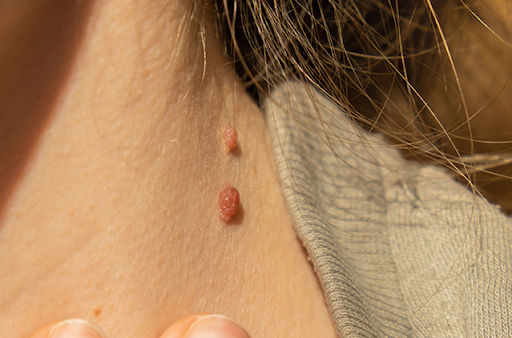
You spot a small bump on your neck and wonder what it is. A skin tag? A wart? Perhaps a mole that has changed?
The uncertainty is stressful. A friend suggests scissors, and the internet offers a dozen home remedies. Worrying about skin growth can chip away at your confidence.
The good news is that you can learn to tell these growths apart. Here is what modern dermatology says about recognizing each one, and when skin tag removal is a safe next step.
Skin Tags, Warts and Moles: What Each One Really Is
These three growths can look alike at first glance. Yet each forms for a different reason, and each needs a different approach.
Skin Tags
- What it is: A small, soft growth on a thin stalk, also called an acrochordon (the medical term for a skin tag). It is made of normal skin tissue and is benign (non-cancerous).
- Where it appears: Skin folds and friction areas, such as the neck, underarms, groin, and eyelids.
- Why it forms: Rubbing in skin folds and family history are commonly linked to skin tags. They are not caused by a virus, so they do not spread from person to person.
- How it feels: Soft and movable, usually the same color as your skin or slightly darker.
Warts
- What it is: A benign growth caused by HPV (human papillomavirus), a virus that infects the top layer of skin.
- How it looks: Often rough or grainy. Some show tiny black dots, which are clotted blood vessels.
- Why it matters: Warts are contagious and can spread to other body parts. A wart may take a few months to appear after HPV infection, according to the American Academy of Dermatology (AAD).
- Where it appears: Most often on the hands and feet.
Moles
- What it is: A cluster of pigment cells called melanocytes (the cells that give skin its color).
- How it looks: Flat or raised, and usually a single shade of brown, tan, or darker.
- What is normal: Most moles are harmless and stay stable for years.
- What is not: A mole that changes needs a doctor’s attention.
Warning Signs: When to See a Dermatologist First
Never remove a mole at home, and never assume a growth is a skin tag. Some skin cancers can look like harmless bumps. Dermatologists use the ABCDEs of melanoma to spot moles that need a closer look:
- Asymmetry: One half of the spot does not match the other.
- Border: The edges are irregular, scalloped, or poorly defined.
- Color: Shades vary within one spot, such as tan, brown, black, red, white, or blue.
- Diameter: Melanomas are often larger than 6 mm (the size of a pencil eraser), but smaller ones exist.
- Evolving: The spot changes in size, shape, or color, or it itches or bleeds.
Book a visit with a dermatologist in these situations too:
- A “skin tag” that bleeds: Bleeding, color change, or fast growth needs an examination.
- A wart that spreads or hurts: Warts that multiply or resist treatment should be assessed.
- Growths in the genital area: These need a proper medical evaluation.
- A weakened immune system: The body may struggle to clear warts on its own.
It is natural to feel anxious about a changing spot. The reassuring part is that most growths are harmless, and a quick examination can give you clarity.
Why Home Removal Is Risky
Cutting, tying, or burning a growth at home may feel like a quick fix. Dermatologists advise against it for good reasons.
- Bleeding and infection: Skin tags can bleed when cut, and unsterile tools invite infection.
- Scarring and dark marks: Vinegar and harsh acids can cause chemical burns. On Indian skin, these often leave dark marks.
- Wrong diagnosis: A mole or wart can be mistaken for a skin tag.
- Wrong product: Wart removers are made for tougher growths and can damage the soft skin around a tag.
According to Dr. Chytra V. Anand, Founder of Kosmoderma Skin, Hair, Body Clinics, “A growth that looks harmless is not always harmless. Every new or changing spot deserves a dermatologist’s examination before removal.”
When Skin Tag Removal Makes Sense
Skin tags are harmless, so removal is a personal choice. Many people consider it for comfort or appearance.
- Irritation: Tags can rub against jewelry, collars, or seat belts, and they can catch while shaving.
- Bleeding: A snagged tag may bleed or become sore.
- Appearance: A tag on the face or neck can affect confidence, and wanting it gone is a valid reason.
- Diagnosis first: A dermatologist should confirm the growth is a skin tag before any treatment.
The AAD notes that dermatologists can remove skin tags during an office visit, usually without a follow-up appointment. The method depends on the size and location of the tag, and dermatologist-performed skin tag removal options can be matched to your skin type. Common methods include:
- Cryosurgery: Liquid nitrogen freezes the tag. A small blister or scab may form.
- Snip excision: After numbing, sterile scissors or a blade removes the tag.
- Electrosurgery: A small electrical current removes the tag and helps control bleeding.
- Laser skin tag removal: Focused light energy removes the tag, as explained below.
How Laser Skin Tag Removal Works
- The science: Laser skin tag removal uses focused light energy that heats and vaporizes the tag tissue. The area is numbed first.
- Best for: Small to medium tags that a dermatologist has confirmed as benign.
- Sessions: Many people need one visit for a few small tags. New tags can still form in other areas.
- Downtime: A small scab forms and usually heals over about a week or two. Mild redness is common.
- Indian skin note: Darker skin tones (Fitzpatrick types III to VI) can develop post-inflammatory hyperpigmentation, or PIH (a dark mark after skin injury). Careful settings and sun protection help.
- Who should wait: Anyone with an active infection, a tendency toward keloids (thick, raised scars), or a recent tan. Tell your doctor about pregnancy and any blood-thinning medicines.
Aftercare Basics
- Keep it clean: Wash the area gently and cover it as advised.
- Do not pick: Let the scab fall off on its own.
- Protect from the sun: Apply a broad-spectrum sunscreen of SPF 30 or higher on the treated area.
Conclusion
Skin tags, warts, and moles may look similar, but they are very different. Skin tags are harmless folds of skin. Warts come from a virus. Moles need watching for any change.
Skin tag removal is easier and safer once you know what you are dealing with. If a growth worries you, an examination by a qualified dermatologist can replace guesswork with clarity and can save you time, money, and frustration.
About the Author: Dr. Nishtha Patel, MBBS, MD in Dermatology, is a Dermatologist and the Medical Head & Consultant of Kosmoderma Skin, Hair & Body Clinics. To learn more about the clinic’s approach to pigmentation concerns, visit Kosmoderma.
Disclaimer: This article is for educational purposes only and is not a substitute for professional medical advice, diagnosis, or treatment. Always consult a qualified dermatologist before starting any treatment. Results vary from person to person.












+ There are no comments
Add yours