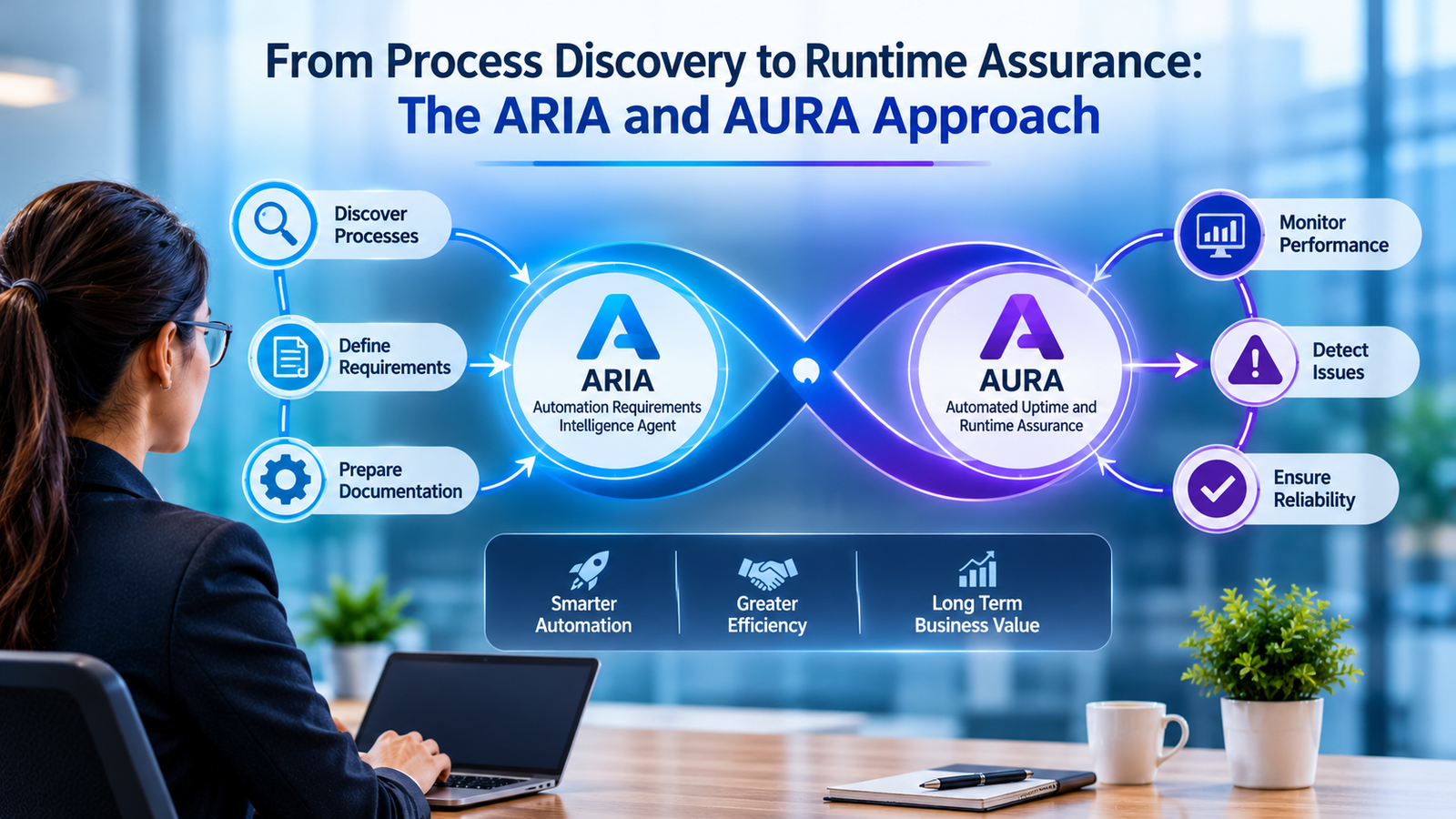
Building an automation solution is only one part of running a successful enterprise automation program. Businesses also need to understand their processes before automation begins and ensure that automated workflows continue performing reliably after they go live. Unfortunately, these responsibilities are often handled by different teams using separate tools and documentation.
This separation creates operational gaps. Developers may receive incomplete requirements, while support teams struggle to understand why an automation failed. AutomationCOE addresses this challenge by connecting two important stages of the automation lifecycle through its AI agents, ARIA and AURA.
Why Enterprises Need a Connected Automation Lifecycle
Consider a company that automates its invoice processing operations. Before development begins, business analysts document how invoices are received, verified, approved, and recorded. Once the automation goes live, the operations team monitors its performance.
Now imagine that the accounting application changes its interface or the database becomes unavailable. The bot may stop processing invoices, even though its original workflow was documented correctly.
The problem is not necessarily the automation logic. It could be an external dependency that was not visible during initial planning.
This explains why enterprises need more than successful automation development. They need a consistent connection between process requirements and production performance.
Without this connection, organizations often experience:
- Incomplete process documentation and repeated clarification.
- Lost business context during team handovers.
- Delayed identification of application and infrastructure failures.
- Higher maintenance costs and operational interruptions.
- Limited visibility into automation performance.
ARIA: Turning Process Knowledge Into Automation Requirements
ARIA stands for Automation Requirements Intelligence Agent. It is AutomationCOE’s AI intake agent, designed to convert process recordings into structured documentation.
Traditionally, business analysts spend considerable time observing employees, conducting interviews, and preparing Process Definition Documents (PDDs). ARIA simplifies this work by analyzing process recordings and extracting relevant information.
Its capabilities include:
Process recording analysis: ARIA examines recorded workflows to understand user activities, application interactions, and process sequences.
Automated documentation: It generates PDDs, test cases, feasibility analysis, complexity scores, and effort estimates.
Clarification and validation: When information is unclear, ARIA can ask targeted questions rather than relying on assumptions.
Data privacy: It detects and anonymizes personally identifiable information (PII) before sharing generated outputs.
According to AutomationCOE, ARIA delivers 92% faster documentation compared with a manual business analyst process.
The result is a more structured starting point for development teams, with less time spent collecting and organizing requirements.
AURA: Keeping Automation Reliable After Go Live
Once an automation enters production, its performance depends on several connected components. These include applications, APIs, databases, infrastructure, and underlying systems.
AURA, which stands for Automated Uptime and Runtime Assurance, is AutomationCOE’s AI runtime agent. Its purpose is to monitor these dependencies and identify conditions that could affect automation reliability.
Unlike basic monitoring tools that primarily report failures after they occur, AURA focuses on understanding system readiness, identifying potential issues, and investigating incidents.
Its key capabilities include:
Pre execution readiness checks: AURA validates environment conditions, device health, application latency, and database readiness before a bot runs.
Dependency monitoring: It maps connections between bots, applications, services, and infrastructure.
Real time monitoring: It tracks automation executions and identifies operational problems.
Root cause analysis: It traces incidents to their underlying causes and recommends mitigation and recovery actions.
AutomationCOE reports 70% fewer incidents and five times faster root cause analysis with AURA.
These capabilities help operations teams move beyond simply responding to failures and gain better visibility into the factors affecting production performance.
How ARIA and AURA Work Together
The real advantage comes from connecting both agents instead of treating discovery and monitoring as unrelated activities.
AutomationCOE follows a 5D1S lifecycle: Discover, Document, Define, Develop, Deploy, and Support.
ARIA covers the first three stages, while development teams build the automation using platforms such as UiPath, Automation Anywhere, Blue Prism, or Microsoft Power Automate. AURA supports the Deploy and Support stages.
Here is how the connection works:
- Discover: A business user records an existing process, giving ARIA the information needed to understand the workflow.
- Document and Define: ARIA prepares the PDD, test cases, feasibility analysis, and other requirements for review.
- Develop: Development teams use the approved requirements as the foundation for building automation.
- Deploy and Support: AURA checks system readiness, monitors dependencies, and tracks production performance.
- Improve future decisions: Runtime insights reveal recurring failures and dependency issues, helping Automation CoE leaders make better decisions when selecting future automation opportunities.
This creates a feedback loop where operational experience can improve future discovery and planning.
Business Benefits of Connecting Discovery With Runtime Assurance
Connecting both stages creates value across business and technology teams.
- Reduced operational costs: Less manual documentation and fewer production incidents help control total cost of ownership.
- Better collaboration: Business analysts, developers, and support teams work with more consistent information.
- Improved reliability: Readiness checks and dependency monitoring help identify problems before they disrupt business activities.
- Stronger governance: Standardized documentation, privacy controls, and operational records support audit requirements.
- Smarter prioritization: Production insights help leaders identify which processes deserve attention next.
These benefits are particularly relevant to banking, insurance, healthcare, manufacturing, retail, and IT organizations where automation reliability and data protection are important.
Building a More Reliable Automation Future With AutomationCOE
Enterprise automation should be viewed as an ongoing business capability rather than a collection of individual bot deployments.
ARIA helps organizations understand what needs to be automated and prepares the requirements. AURA helps maintain operational reliability by monitoring the systems and dependencies that support those automations.
By connecting both agents, AutomationCOE brings greater continuity to the automation lifecycle. Businesses can reduce documentation gaps, improve operational visibility, and make decisions using information gathered from both process requirements and production performance.







+ There are no comments
Add yours