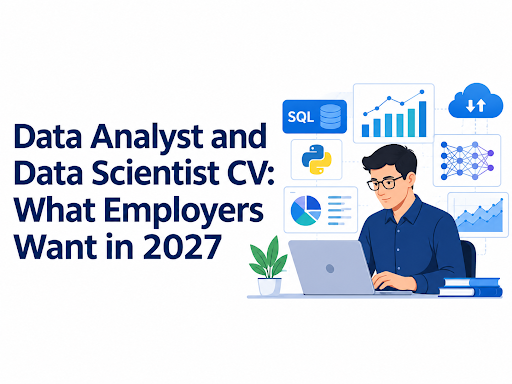
Learn what employers expect on a data analyst or data scientist CV in 2027, from SQL and Python to projects, business impact and AI skills.
Data roles keep evolving. A few years ago, strong Excel and SQL skills could win a data analyst job. In 2027, employers also want cloud familiarity, business insight and the ability to work responsibly with AI tools. At the same time, hundreds of applicants compete for each opening, so your CV must show clearly what you can do and why it matters.
This guide explains what UK and Irish employers expect on a data analyst or data scientist CV and how to present it.
Analyst or Scientist: Choose Your Lane
The titles overlap, but they are not identical:
- Data analyst: cleans and analyses data, builds dashboards and reports, and helps teams make decisions
- Data scientist: builds statistical and machine learning models, runs experiments and predicts outcomes
- Analytics engineer or data engineer: builds the pipelines and models that others rely on
Your CV should lean towards one. If you are applying for both, create two tailored versions rather than one vague document.
What Employers Want in 2027
Across job adverts, several themes appear consistently:
- Strong SQL. Still the most commonly requested skill.
- Python or R for analysis, automation and modelling.
- Business intelligence tools such as Power BI, Tableau or Looker.
- Cloud data platforms such as Snowflake, BigQuery, Databricks or Azure Synapse.
- Data modelling and quality. Employers value people who build reliable, well-documented datasets.
- Communication. The ability to explain findings to non-technical colleagues.
- Responsible AI and governance. Awareness of GDPR, bias and appropriate use of AI tools.
You don’t need every item, but your CV should show depth in the ones that match the role.
Write a Profile That Shows Impact
Replace vague statements with a short, evidence-led summary. For example: “Data analyst with three years’ experience in retail, building Power BI dashboards that helped reduce stock waste by 18 percent. Skilled in SQL, Python and stakeholder reporting.” In three lines, the reader knows your field, tools and result.
Structure Your Skills Section
Group technical skills so they are easy to scan:
- Languages: SQL, Python (pandas, scikit-learn), R
- Visualisation: Power BI, Tableau, Looker Studio
- Data platforms: Snowflake, BigQuery, Azure, AWS
- Methods: A/B testing, regression, forecasting, segmentation
- Practices: version control, documentation, data validation
Be honest about proficiency, since technical interviews often include live SQL or case exercises.
Turn Experience Into Business Outcomes
Employers care less about the model you built than what it changed. Pair each task with a result:
- “Built a customer churn model that identified at-risk accounts, supporting a retention campaign that saved an estimated €250,000.”
- “Automated weekly reporting with Python, saving the team around eight hours per week.”
- “Designed a sales dashboard used by 40 managers, reducing ad hoc data requests by 30 percent.”
If you cannot share exact figures, use ranges or relative improvements, such as “reduced processing time by more than half.”
Showcase Projects and Portfolios
Projects are especially important for career changers and early-career applicants. Choose two or three that demonstrate different skills, such as data cleaning, visualisation and modelling. For each, give the problem, data source, methods, tools and result. Link to GitHub, Kaggle or a simple portfolio site, and make sure each project has a clear README explaining your approach and findings.
Use real or realistic datasets, and avoid projects that simply copy popular tutorials. A project tied to a real question, such as analysing local housing prices or public transport delays, stands out.
Education, Certifications and Learning
List your degree, relevant modules and any dissertation with a data focus. Useful certifications include Microsoft PL-300 (Power BI), Google Data Analytics, Databricks or cloud platform credentials. Keep the section short and relevant, and add recent courses to show you are keeping up to date.
Graduates and Early-Career Candidates
If you are new to the field, emphasise coursework, internships, projects and competitions. Many applicants in the capital use Graduate resume Writing Services dublin to translate dissertations and academic projects into outcomes that employers understand, which can be a big help when you have little formal experience.
Marketing and Commercial Analytics
Marketing analytics, customer insight and digital performance roles sit between data and commercial teams. If you are applying to these, your CV needs to show both analytical skill and campaign impact, and marketing Resume writing services ireland can help present attribution models, conversion rates and ROI in language marketing leaders recognise.
Keep It ATS-Friendly
Use a single-column layout, standard headings and plain text. Include role-specific terms from the advert, such as “data modelling,” “stakeholder reporting,” “forecasting” or “ETL,” where they truthfully apply. Avoid charts, icons and graphics in the CV itself, and save visuals for your portfolio.
Where Professional Help Fits
Data professionals are used to precision, but writing about themselves can feel unnatural. A good Irish CV Writing Service can help you decide which projects to feature, how to quantify your impact and how to match your document to Irish and UK hiring conventions. Check that the provider asks about your target roles, offers a clear revision policy and can show anonymised samples for technical candidates.
Quick Checklist
- A specific profile with a measurable result
- Skills grouped by type and honestly rated
- Experience bullets that show business impact
- Two or three strong, well-documented projects
- Relevant certifications and recent learning
- A clean, ATS-friendly layout
- Tailoring for each application
Final Thoughts
In 2027, the best data CVs combine technical depth with business impact. Show that you can analyse data, communicate findings and work responsibly with new tools. When your document makes those strengths clear within seconds, you give employers in the UK and Ireland a strong reason to invite you to interview.









+ There are no comments
Add yours