
CBSE exam preparation can feel confusing when every student around you is using a different method. One friend is solving sample papers every day. Another is reading NCERT line by line. Someone else has a stack of notes, question banks, and previous year papers.
So what actually works?
The answer is not one resource. It is the order in which you use them.
CBSE Important Questions help you revise chapter-wise. Sample papers help you test your full exam readiness. NCERT builds your base. A mistake notebook shows where you are losing marks. When these four things work together, preparation becomes clearer and less stressful.
Students who score well usually don’t study randomly. They practice with a plan, check their mistakes, and improve answer writing before the exam.
Why CBSE Important Questions Are Useful
Important questions are not shortcuts. They are practice filters.
A good set of important questions helps students identify the kind of concepts, definitions, numericals, diagrams, and long-answer formats that often matter in exams. They also help you check whether you understood a chapter well enough to answer exam-style questions.
For chapter-wise preparation, students can use CBSE Important Questions after completing each topic. This is better than waiting until the full syllabus is over.
Why?
Because mistakes are easier to fix when the chapter is still fresh.
For example, if you finish “Light” in Class 10 Science, solve important questions from that chapter within a day or two. You may find that you understand ray diagrams but lose marks in image formation explanations. That small discovery is valuable. It tells you exactly what to revise.
The same method works for Class 12 subjects like Physics, Chemistry, Accountancy, Economics, Business Studies, Mathematics, and Biology. Important questions help you break a large syllabus into smaller practice blocks.
The Right Way to Solve Important Questions
Many students use important questions incorrectly. They open the solution first, read the answer, and feel prepared.
That is not practice. That is recognition.
Real practice starts when you attempt the question without help. Write the answer as you would write it in the exam. Then compare it with the solution or marking points.
A better method looks like this:
- Read the chapter from NCERT or class notes
- Close the book
- Attempt important questions in writing
- Check the answer
- Mark missing points
- Rewrite weak answers
- Revise the same question after a few days
This process may feel slower, but it builds actual exam confidence.
A student who only reads answers may feel prepared until the question is slightly changed. A student who practices writing can handle variations because the concept is clear.
Why Sample Papers Are Needed After Chapter Practice
Important questions improve chapter strength. Sample papers test exam performance.
There is a difference.
A student may solve chapter questions correctly but still struggle in a full paper because of time pressure. In a board exam, you need to manage sections, choose questions wisely, keep handwriting readable, and complete answers within the limit.
That is why solving a CBSE Sample Paper is useful after completing enough syllabus revision.
A sample paper shows:
- Whether you can finish on time
- Which sections take too long
- Where you make careless mistakes
- Whether your answers match the marking scheme
- How well you handle mixed chapters
Do not solve sample papers casually. Sit in a quiet place. Keep a timer. Avoid checking answers in between. Treat the paper like a real exam.
Then spend enough time checking it. The checking part is where improvement happens.
Important Questions vs Sample Papers: Which Comes First?
Start with important questions. Move to sample papers later.
If your chapter knowledge is weak, a full sample paper can make you feel anxious. You may leave half the paper blank and assume you are bad at the subject. That may not be true. You may simply need more chapter-wise practice.
The correct order is:
- NCERT reading
- Class notes revision
- Chapter-wise important questions
- Mixed practice
- Full sample papers
- Mistake correction
This order works because it moves from concept to application.
Think of it like preparing for a sport. You don’t start by playing the final match every day. You first practice skills, then play full matches to test your stamina and strategy.
A Realistic Example for a CBSE Student
Let’s say Meera is in Class 12 and preparing for Economics. She understands the theory but loses marks in long answers because her points are not structured.
She starts by revising one chapter from NCERT and her school notes. Then she solves important questions from that chapter. While checking answers, she notices three problems:
- She writes too much background before answering
- She forgets keywords
- She does not use examples where needed
Now she creates a small correction page for that chapter. It includes keywords, diagrams, formulas, and answer formats.
After three chapters, she solves a section from a sample paper. Her score improves because she is not just reading theory anymore. She is training herself to answer like the exam expects.
This is the same discipline students need in college-level academic work. Technical subjects, for instance, require step-wise explanation and accuracy, which is why many learners look for engineering assignment support when they need help understanding complex academic tasks.
The lesson is simple: good academic performance depends on structure, not just effort.
The Common Mistake: Solving Without Reviewing
The biggest mistake students make is counting how many questions they solved instead of checking what they learned.
Solving 100 questions is not useful if you repeat the same mistake 100 times.
After every practice session, divide mistakes into categories:
Concept mistake: You did not understand the topic.
Memory mistake: You forgot a formula, definition, date, or keyword.
Presentation mistake: Your answer lacked steps, points, labels, or clarity.
Time mistake: You knew the answer but took too long.
This simple classification saves time. It tells you what kind of revision is needed.
If it is a concept mistake, go back to NCERT.
If it is a memory mistake, revise formulas or keywords.
If it is a presentation mistake, rewrite answers.
If it is a time mistake, practice under a timer.
A mistake notebook may look ordinary, but it becomes one of the strongest revision tools before exams.
How Answer Writing Affects Marks
CBSE exams do not reward only knowledge. They reward clear expression of knowledge.
This is where many students lose marks.
They know the answer but write it vaguely. They understand the concept but skip steps. They draw diagrams without labels. They write long paragraphs when the question asks for two points.
Good answer writing means giving the examiner what the question demands.
For Maths and numericals:
- Write formulas
- Show steps
- Mention units
- Avoid skipping calculations
For Science:
- Use correct terms
- Label diagrams
- Explain reasoning clearly
- Write balanced equations where needed
For Social Science:
- Use points
- Include dates, terms, causes, and effects
- Keep answers direct
- Avoid unnecessary stories
For English and language subjects:
- Keep grammar clean
- Write with flow
- Answer the exact question
- Use examples where suitable
Strong language skills help across subjects. Students preparing for language-based exams already know the value of English communication skills, but the same clarity also improves CBSE answers, especially in theory papers.
How to Use Sample Papers Without Wasting Them
Many students download sample papers but do not use them properly.
A sample paper should not be treated like a worksheet. It should be treated like a full exam rehearsal.
Here is a better method:
First, revise the important concepts. Then attempt the paper in one sitting. Do not pause for snacks, phone calls, or checking notes. Once the paper is complete, take a short break. After that, check answers carefully.
Write down:
- Questions left unanswered
- Questions where you guessed
- Questions where you lost marks
- Questions that took too much time
- Topics that need revision
After checking, do not immediately jump to the next paper. Spend one or two days fixing the mistakes from the previous paper.
That is how sample papers improve marks.
If you solve paper after paper without correction, you are only practicing speed, not accuracy.
Weekly Study Plan Using Important Questions and Sample Papers
A practical weekly plan is better than a perfect timetable that nobody follows.
Try this:
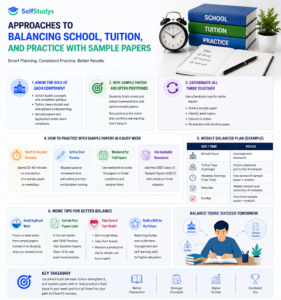
Monday: Revise one chapter and solve important questions
Tuesday: Check mistakes and rewrite weak answers
Wednesday: Study another chapter and solve short questions
Thursday: Practice long answers, diagrams, or numericals
Friday: Mixed revision from two chapters
Saturday: Attempt one timed section or sample paper
Sunday: Review mistakes and update your notebook
When exams are far away, focus more on important questions. When exams are close, increase sample paper practice.
This balance keeps preparation steady.
How Parents Can Support Students
Parents often ask students to study for more hours. Sometimes that helps. Often, it does not.
A better question is: what did the student improve today?
Did they fix a weak chapter?
Did they complete a timed paper?
Did they correct mistakes?
Did they revise formulas?
Did they practice answer writing?
These questions are more useful than simply counting study hours.
Students also need breaks. A tired mind reads pages without remembering anything. Short, focused sessions with proper review are more effective than long, distracted study hours.
Last-Minute Revision Strategy
In the final week, do not try to learn everything from the beginning. Focus on high-return revision.
Revise:
- Important formulas
- Definitions
- Diagrams
- Map work
- Marking scheme patterns
- Mistake notebook
- Previously difficult questions
- One or two sample paper sections
Avoid starting too many new resources. New material at the last moment can create panic.
Use important questions for quick chapter recall and sample papers for exam rhythm. Keep the final days simple and focused.
FAQ
Are CBSE Important Questions enough for board exams?
No. They are useful for focused revision, but students should also study NCERT, class notes, textbook exercises, and sample papers.
Should I solve sample papers before finishing the syllabus?
You can solve section-wise practice early, but full sample papers are more useful after completing most of the syllabus.
How many sample papers should I solve?
Quality matters more than number. Five well-reviewed sample papers can help more than fifteen papers solved without checking mistakes.
Can important questions help in last-minute revision?
Yes, they are useful for revising key concepts, formulas, definitions, diagrams, and expected question formats.
How do I improve my CBSE answer writing?
Practice writing answers, compare them with solutions, note missing points, and rewrite weak answers. Pay attention to keywords, steps, labels, and structure.
Conclusion
CBSE preparation becomes easier when every resource has a clear role. NCERT builds the base. Important questions sharpen chapter practice. Sample papers test exam readiness. A mistake notebook shows what still needs work.
The students who improve fastest are not always the ones who study the longest. They are the ones who notice where marks are slipping and fix those gaps before the final paper.












+ There are no comments
Add yours