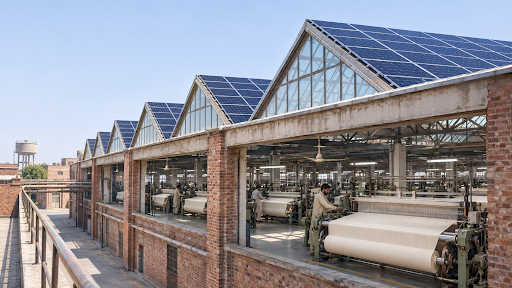
Walk through a spinning or weaving unit in Karachi, Faisalabad, or Lahore on a summer afternoon, and you’ll hear it before you see it: looms clattering, ring frames humming, and air conditioning fighting the heat. Electricity is one of the largest costs in textile production, and for many mill owners it’s the cost that keeps climbing. So the question comes up often: if we put panels on our roof, how much of our power bill can they actually cover?
The honest answer is “a meaningful share, but rarely all of it.” Here’s how to think it through.
Why Textile Mills Are a Good Fit for Solar
Textile mills have a few things going for them when it comes to solar.
Most run during the day. Many units operate in one or two shifts, and the heaviest machinery is busiest when the sun is up. That matters because a rooftop system produces the most power at midday, and if your factory uses that power right away, you avoid selling it back to the grid at a lower price or losing it entirely.
Mills also tend to have large, flat roofs. Sheds and warehouse-style buildings give you the square footage that solar needs, and the roof is often underused.
Finally, electricity is a big line item. Every unit of grid power you replace with your own generation is a direct saving, so the financial logic is easy to follow.
The Simple Math Behind the Roof
A rough rule of thumb in Pakistan is that 1 kilowatt-peak (kWp) of solar panels produces about 4 units (kWh) of electricity on an average day, depending on season, dust, and system quality. Panels also need space. Allowing for spacing and walkways, plan on roughly 6 to 7 square meters of roof per kWp.
Let’s make it concrete with an example. Imagine a mid-sized spinning unit that uses about 6,000 kWh per day on average. Suppose it has a clear, unshaded roof of 10,000 square meters. That roof could hold something like 1.5 MWp of panels, which would generate roughly 6,000 kWh on an average day.
On paper, that looks like it covers the whole load. In practice, it doesn’t work out that neatly, for three reasons:
- Not all the power is used when it’s made. Solar output peaks around noon, but factory demand may not be flat across the day. Any surplus has to go somewhere, and that’s where the rules get complicated.
- Mills run around the clock. Night shifts, or simply the early morning and evening hours, draw power that solar can’t supply without batteries. Batteries are still expensive for industrial-scale use, so most mills stay connected to the grid for those hours.
- Weather and dust matter. Cloudy days, monsoon season, and dust buildup on panels all reduce output. Textile areas can be dusty, so regular cleaning is not optional.
Once you account for these, a realistic outcome for many mills is that rooftop solar covers somewhere in the range of 25 to 40 percent of total electricity consumption. Some mills with very large roofs and high daytime load can go higher, but few reach 100 percent without significant storage or additional sources.
What Determines Your Own Number
Every mill is different, so the right way to estimate is to look at your own situation. The biggest factors are:
- Usable roof area. Check how much of it is free of water tanks, skylights, HVAC units, and shading from nearby structures.
- Load profile. A detailed look at your meter data, ideally in 15-minute intervals, shows when you use power and how much. This tells you how much of your solar output you can use directly.
- Shift pattern. A single day shift is a strong match for solar. Three shifts mean more hours of grid dependence.
- Roof condition and structure. Older sheds may need reinforcement before panels go on, and that cost belongs in the calculation.
- Grid rules and tariffs. Net-metering and net-billing policies have been revised over time, and the rules around exporting surplus power and how it’s credited can change. Before you commit, confirm the current requirements with your distribution company and NEPRA, since they directly affect how much value your surplus generation returns.
Making the Most of the System
If you’re considering a system, a few practical steps help you get closer to the upper end of that range:
- Size the system to your daytime consumption, not your roof size. Oversizing can leave you with surplus you can’t use or sell well.
- Schedule energy-intensive processes, such as certain dyeing or processing steps, during peak solar hours where possible.
- Invest in regular panel cleaning and monitoring. A simple monitoring dashboard can flag underperforming strings before they cost you real money.
- Get quotes from several providers and ask them to show their estimates using your actual meter data, not generic assumptions.
The Bottom Line
For most textile mills, rooftop solar won’t replace the grid completely, but it can cut a large and growing portion of the electricity bill, often somewhere between a quarter and two-fifths of consumption depending on roof size and load pattern. The payback period, the rules for surplus power, and the best system design all depend on your specific numbers.
If you’re exploring solar energy solutions for your mill, the most useful first step is a site assessment with a review of at least 12 months of your electricity bills and, if possible, interval meter data. That turns a rough guess into a plan you can actually budget for.












+ There are no comments
Add yours