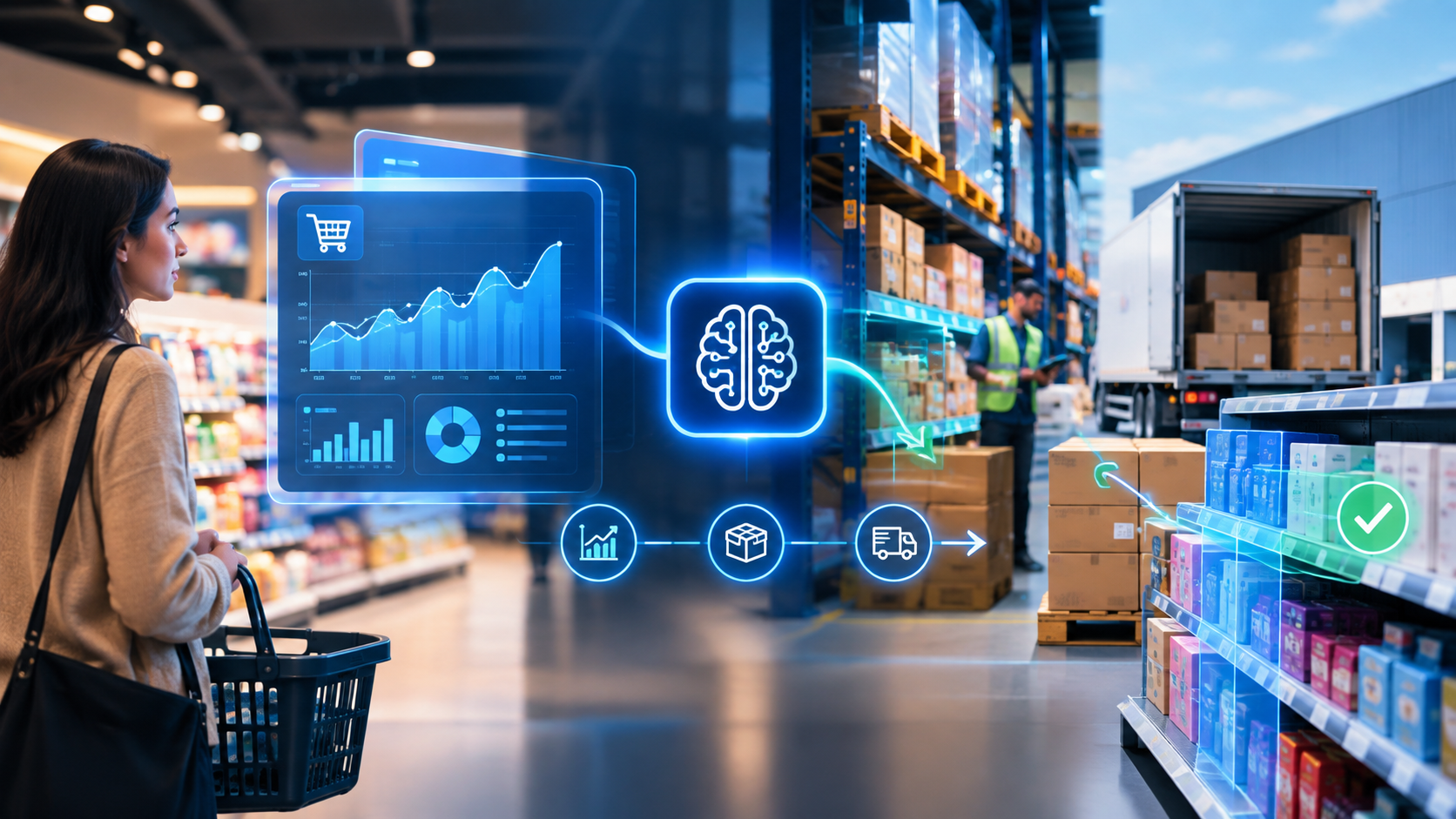
AI prevents stockouts by spotting inventory risk early and connecting that prediction to replenishment action.
Retailers do not usually lose sales because they have no inventory anywhere. They lose sales because the right product is not available at the right location when the customer wants it.
A warehouse may have thousands of units. Another store may have excess stock. Yet the shelf in front of the customer can still be empty.
This is where AI changes the equation.
Instead of relying only on fixed reorder points and yesterday’s sales reports, AI can continuously evaluate demand, sales velocity, available inventory, incoming shipments, and supplier lead times. When it detects that a product is likely to run out, it can support the next decision before the stockout actually occurs.
The shift is simple but important: retailers move from reacting to empty shelves to managing inventory risk before it becomes visible to customers.
The Real Reason Retail Stockouts Happen
Stockouts are often treated as an inventory problem. In reality, they are usually a timing and decision problem.
Consider a retailer selling the same product across 200 locations.
Sales suddenly increase at 20 stores because of a local event, a promotion, or a change in consumer behavior. The retailer may still have sufficient inventory overall. However, the inventory is distributed based on an older demand pattern.
By the time the planning team reviews the numbers, some locations are already out of stock.
Traditional inventory processes struggle here because many of them depend on predetermined rules.
For example:
- Reorder when stock falls below a certain level
- Review inventory once a day or once a week
- Use historical sales as the primary forecasting input
- Apply similar safety stock levels across multiple locations
The issue is not that these methods are completely ineffective. The issue is that demand does not follow fixed rules.
A product that normally sells 20 units a day may suddenly sell 70.
If the system only reacts after inventory reaches a threshold, the retailer is already operating too close to the stockout.
How AI Sees a Stockout Before It Happens
AI demand forecasting does more than calculate an average based on previous sales.
It can examine multiple demand signals together and identify when current buying behavior is moving away from the expected pattern.
Depending on the available data, this can include:
- Historical sales
- Current sales velocity
- Seasonal demand
- Promotions
- Store level purchasing patterns
- Ecommerce activity
- Product availability
- Supplier lead times
- Inventory movement across locations
The important difference is context.
A traditional system may see that sales increased.
AI can help determine whether the increase is temporary, location specific, seasonal, or the beginning of a larger demand shift.
That distinction matters because not every increase in sales should trigger the same replenishment response.
For a retailer managing thousands of SKUs, this creates a much more detailed view of demand.
Instead of asking, How many units will we sell next month?
The better question becomes:
Which product is at risk, at which location, and how much time do we have to respond?
Forecasting Does Not Prevent Stockouts. Action Does.
This is where many discussions about AI in retail stop too early.
A demand forecast is useful. But a forecast sitting inside a dashboard does not refill a shelf.
The real value comes when forecasting is connected to inventory replenishment.
Suppose a system predicts that a particular SKU will run out in four days.
The next step is not simply sending an alert.
The system needs to determine:
- Is more inventory available in a warehouse?
- Does another store have excess stock?
- Is an inbound shipment already scheduled?
- How long will the supplier take to deliver?
- Should a purchase order be prioritized?
- Is the predicted demand increase likely to continue?
Once these questions are connected, replenishment becomes a decision process rather than a manual reporting exercise.
The retailer is no longer waiting for someone to notice a problem. The system is identifying the risk and providing a path to address it.
AI Agents Can Connect the Entire Replenishment Process
The next level of automation is not just better forecasting. It is connecting forecasting with operational decisions.
This is where AI agents can support retail teams.
An AI agent can monitor inventory conditions, identify a potential shortage, check stock across locations, review supplier information, and prepare the appropriate replenishment action.
For example, instead of a planner manually moving between the demand forecast, ERP system, warehouse platform, and supplier data, the AI agent can bring the relevant information together.
The planner can then focus on decisions that require business judgment.
This is especially useful for enterprise retailers where stock availability involves multiple systems and teams.
The challenge is rarely a lack of data.
The challenge is that the data needed to make one decision is spread across different platforms.
AI agents can help reduce that gap between insight and operational action.
Why Real Time Inventory Visibility Matters
Retailers can have plenty of inventory and still experience stockouts.
That sounds contradictory, but it happens frequently.
Imagine a retailer with 5,000 units of a product across its network.
One distribution center has 2,000 units.
Several stores have excess inventory.
A high demand store has zero.
From an enterprise perspective, inventory is available. From the customer’s perspective, the product is unavailable.
This is why real time inventory management matters.
AI can evaluate not only how much inventory exists but where that inventory is located and whether it can be moved or allocated quickly enough to meet demand.
This supports smarter decisions such as:
- Reallocating stock between locations
- Prioritizing high demand stores
- Adjusting fulfillment decisions
- Identifying slow moving inventory that can be redistributed
- Updating replenishment priorities
The goal is not simply to maintain more inventory.
The goal is to maintain better positioned inventory.
Preventing Stockouts Without Creating Overstock
Ordering more inventory may reduce stockouts, but it can create another expensive problem.
Overstock.
Excess products occupy warehouse space, increase carrying costs, and can eventually require markdowns.
Retailers therefore need to balance two competing risks:
Too little inventory means lost sales.
Too much inventory means unnecessary cost.
This is where inventory optimization becomes important.
AI can evaluate demand variability, product movement, supplier reliability, and location level performance to recommend more appropriate inventory levels.
A fast moving product with an unreliable supplier should not necessarily follow the same replenishment rules as a predictable product with a short lead time.
AI allows retailers to move away from one size fits all inventory rules.
The Bigger Shift in Retail Inventory Operations
The real impact of AI is not simply better forecasting accuracy.
It is the ability to shorten the distance between seeing a problem and responding to it.
Retailers are moving toward inventory operations where systems continuously monitor demand and supply conditions.
The workflow becomes more proactive:
Demand changes.
Inventory risk is identified.
Available stock is evaluated.
The best replenishment option is determined.
The appropriate workflow begins.
This is the real journey from demand forecasting to replenishment.
AI does not eliminate every stockout. Supply disruptions, sudden demand spikes, and operational constraints will still exist.
But it gives retailers something traditional inventory processes often lack: time to respond before the customer sees an empty shelf.









+ There are no comments
Add yours