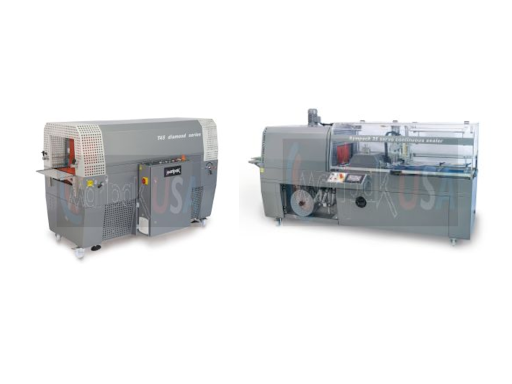
Packaging multiple products together can improve handling, storage, and transportation efficiency across many industries. Shrink film bundling equipment is designed to group products and enclose them in polyethylene film, creating a compact package that can be moved through distribution and retail processes more efficiently. Different machine configurations are available to accommodate varying product sizes, production volumes, and levels of automation.
What Is Shrink Film Bundling Equipment?
Shrink film bundling equipment combines several packaging functions into a controlled process. Products are first arranged into a specific bundle configuration before polyethylene film is applied around them. Depending on the system, the film may then be sealed and passed through a heat tunnel, where controlled heat causes the material to contract around the products.
This process can create a closely fitted package while keeping multiple items together. Industrial PE wrapping systems are commonly configured for manual, semi-automatic, or fully automatic operation.
How Does the Bundling Process Work?
Although machine designs vary, the basic packaging sequence generally includes several stages:
Product collation: Individual products are positioned into the required bundle arrangement.
Film application: Polyethylene film is placed around the grouped products, either manually or through an automated feeding system.
Wrapping and sealing: The film is formed around the products and sealed according to the machine’s operating configuration.
Heat shrinking: When a heat tunnel is integrated into the system, controlled heat causes the film to shrink around the bundle.
Discharge: The finished package exits the system and can continue to storage, palletizing, or distribution.
Automation can reduce the amount of manual handling required between these stages, particularly in higher-volume packaging environments.
Types of Bundling Systems
Different machine configurations address different packaging workflows. The MULTIMAC D, for example, combines automatic sealing and tunnel wrapping within one inline system. The MULTIMAC C incorporates automatic 90-degree feeding and product collation before wrapping.
For operations requiring greater operator involvement, the MULTIMAC P provides manual collation sleeve wrapping. PE-D is designed for fully automatic continuous sleeve wrapping, while the PE-MOTION system provides a high-speed automatic sleeve-wrapping configuration.
These variations allow packaging operations to consider factors such as product arrangement, production volume, available space, and desired automation level when evaluating equipment.
What Should Be Considered Before Choosing Equipment?
Product dimensions are one of the most important considerations because the machine must accommodate the width, length, and height of the intended package. Film type and thickness also influence machine compatibility and the characteristics of the finished package.
Production volume is another key factor. A manual system may suit applications with lower throughput or variable product arrangements, while automated equipment can be more appropriate for continuous production. Feeding and collation requirements should also be evaluated because inconsistent product positioning can affect the wrapping process.
Why Proper Equipment Selection Matters
The right bundling system can help establish a consistent packaging workflow while matching the operational requirements of a particular facility. Factors such as automation, product dimensions, film specifications, throughput, and available floor space should therefore be considered together rather than evaluated separately.
Maripak USA provides a range of industrial polyethylene wrapping, bundling, and packaging equipment, including manual and automated systems. Its product range demonstrates how different machine configurations can address different approaches to product collation, wrapping, sealing, and shrinking.
Conclusion
Shrink film bundling provides an efficient method for grouping products into organized packages for handling, storage, and distribution. We at Maripak USA illustrate the different configurations that can be used for manual, semi-automatic, and fully automated packaging applications. The choice of equipment depends on product characteristics, film requirements, production volume, automation needs, and facility layout. Understanding these factors can help packaging operations select a system that fits their workflow.




+ There are no comments
Add yours