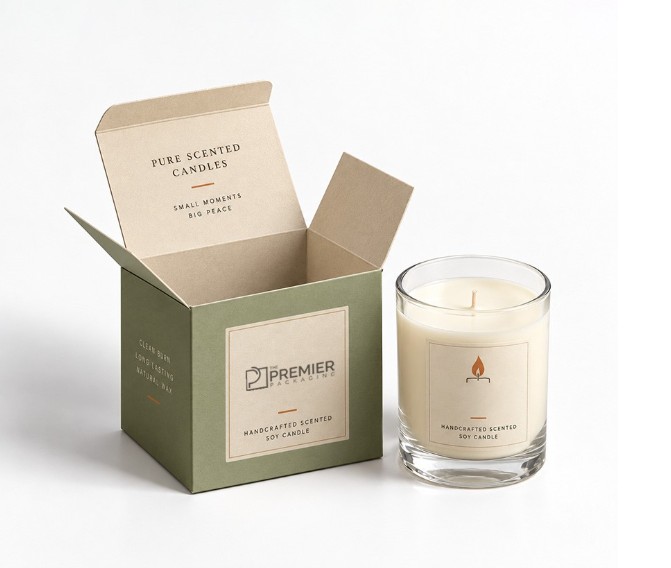
Boxing a candle sounds like a simple measure. Pick a box close to that size, done. Except a surprising number of brands get this wrong in one direction or another, either leaving so much extra room the candle rattles around in transit, or squeezing it into something so tight the jar can’t be removed without prying at the lid. Diameter and height aren’t just measurements you plug into a spec sheet. They actually decide how the box needs to be built.
Why Diameter Matters More Than People Expect
A candle’s diameter drives almost everything about how the box holds it in place. Too much extra space around the jar and there’s room for it to shift sideways during handling, which is exactly the kind of small, repeated movement that chips glass or cracks wax near the rim. Too little space, and the fit becomes a problem in the opposite direction; the jar has to be forced in or out, and forcing anything glass is never a great idea.
Wider candles, the chunky multi-wick jars especially, also change how a box needs to be reinforced. A wide base spreads weight differently than a narrow one, and boxes built without accounting for that can bow or weaken at the sides faster than you’d think, particularly when several candles are stacked or packed close together for shipping.
Why Height Changes the Equation Too
Height affects the box in ways that diameter doesn’t. A taller candle has a higher center of gravity, which means it’s more prone to tipping inside a loosely fitted box during transit — and a candle that’s tipped over for even part of a shipping route usually arrives with wax pooled unevenly or a label that’s shifted out of place.
Shorter, squat candles are generally more stable on their own, but they come with a different issue: if the box is sized for a taller product line and a shorter candle gets dropped into the same box size, there’s often too much vertical space above the jar, and that gap becomes room for the whole thing to bounce during handling.
Matching Box Type to Candle Proportions
Different candle shapes tend to pair better with different box structures, and getting this pairing right solves most sizing issues before they start.
Tall, narrow candles — like pillar-style jars or tall tapered containers — usually do best in a snug, rigid box with a base insert that locks the bottom in place. The height needs support from below, not just side walls, since a tall jar with an unsupported base is the most likely to tip.
Wide, short candles — the popular tumbler and multi-wick styles — need a box with a wider, sturdier base and less concern about height, but more attention to keeping the jar from sliding laterally, since there’s more surface area in contact with the box floor to manage.
Standard mid-size jars, which account for a large share of the market, generally work well with a straightforward fitted box, as long as the internal dimensions are kept close to the actual jar size rather than rounded up for convenience.
A Rough Sizing Reference
| Candle Type | Typical Diameter | Typical Height | Recommended Box Approach |
| Small votive/sample | 2–2.5 in | 2–3 in | Snug-fit box, minimal padding needed |
| Standard single-wick jar | 3–3.5 in | 3.5–4.5 in | Fitted box with base insert |
| Multi-wick wide jar | 4–5 in | 3–4 in | Reinforced base, wider side clearance |
| Tall pillar or tapered jar | 2.5–3.5 in | 5–7 in | Base-locking insert, taller box with tighter fit |
| Apothecary/statement jar | 4–5 in | 5–6 in | Reinforced structure on all sides, minimal internal gap |
These are starting points rather than fixed rules — actual sizing should always be based on the real product dimensions, since even a small variation in a jar’s shoulder or base can change how it fits.
Where Wholesale Sourcing Fits In
Brands producing candles at volume usually aren’t ordering one box size at all — they’re working across a handful of standard sizes that cover most of their product line, then customizing from there. This is where sourcing from wholesale candle packaging suppliers tends to make the most sense, since it allows a brand to get consistent, properly sized stock across multiple jar dimensions without paying custom pricing for every size variation. The trick is choosing a supplier that offers enough size granularity to actually match the range of diameters and heights in a product line, rather than forcing several different candle shapes into two or three generic box sizes.
Getting the Fit Right in Practice
The simplest way to catch sizing problems is to test with the actual candle rather than a rough estimate. A jar that measures correctly on paper can still sit slightly differently in a box once wax weight, label placement, and lid height are factored in. A quick shake test and a short drop test with the real product, before committing to a box size at scale, tends to catch the kind of mismatch that specs alone won’t reveal.
FAQs
How much extra space should a box have around a candle jar?
Generally, as little as possible while still allowing the jar to be inserted and removed without friction, a gap of more than a few millimeters along the sides is usually enough to prevent damaging movement during transit.
Does candle weight matter as much as diameter and height when sizing a box?
It matters, but mostly for base reinforcement rather than overall box dimensions. A heavier candle needs a sturdier base and thicker box walls, even if its diameter and height are similar to those of a lighter product.
Can one box size work for multiple candle products?
Sometimes, if the products are close enough in diameter and height, but stretching one box across a wide size range usually means some products end up too loose. It’s often better to standardize on a few box sizes that closely match actual product groupings.
Why do tall candles need different packaging than short ones, even at a similar diameter?
Height changes the candle’s center of gravity, which affects how likely it is to tip inside the box. Taller candles typically need base-locking support that shorter candles don’t require as urgently.
Is it worth ordering custom box sizes instead of using standard sizes?
For a brand with a lot of size variation across its product line, yes, a closer fit reduces damage and looks more intentional to the customer. For brands with only one or two candle sizes, standard sizing is usually sufficient and more cost-effective.









+ There are no comments
Add yours