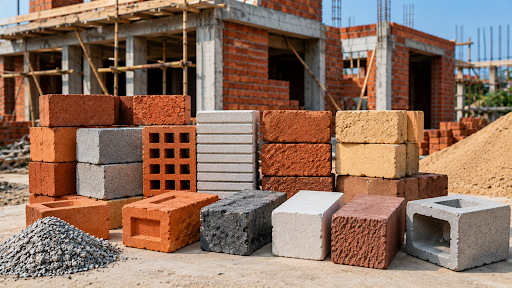
Somebody on every site says it eventually. “Hollow blocks are weak, they have holes in them.”
They do have holes in them. That is the entire point, and it is also the part people misunderstand most.
What the hollows are actually for
Take a solid clay brick and a hollow block of the same outer size. The hollow one weighs noticeably less — often thirty to fifty percent less depending on the design.
That weight is not lost strength. It is removed dead load. Every kilogram you take out of the wall is a kilogram your beams, columns, and foundation no longer have to carry. On a four-storey building, that adds up to real savings in steel and concrete.
The cavities do something else too. Trapped air is a poor conductor of heat, so a hollow wall slows down the heat trying to get from outside to inside. In North India, where a west-facing wall bakes from two in the afternoon until sunset, that difference is not theoretical. You feel it in the room and you see it on the electricity bill.
And there is the sound. The air gaps break up sound transmission, which is why hollow blocks show up so often in hotels, hospitals, and apartment party walls.
Where they belong
Hollow blocks are at their best in framed structures — RCC column and beam construction, where the walls are filling in the frame rather than holding the building up.
Which covers most modern construction in India, honestly.
Good applications:
- Infill walls in RCC framed buildings — the standard use case, and the one they were designed for
- Internal partitions — light, fast to lay, easy to run conduits through
- Top floors and terrace rooms — where heat gain is worst and the insulation matters most
- Compound and boundary walls — fewer units per square metre means faster work
- Apartment separation walls — for the acoustic benefit
Larger unit size is an underrated advantage here. One block covers the area of several bricks, so a mason lays a wall in a fraction of the time. Labour is usually the biggest line item on a wall, not the material.
Where they don’t belong
This part matters more than the sales pitch.
Do not use hollow blocks for load-bearing walls unless the design specifically calls for a load-bearing hollow unit and the structural engineer has signed off on it. Standard infill blocks are not made for that job.
Be careful with heavy fixtures too. A wall-mounted geyser, a heavy cabinet, a TV bracket — these need proper anchors or a solid infill patch planned in advance. Plenty of homeowners have learned this by watching a shelf come out of the wall with a chunk of block still attached to it.
And below damp-proof level, in plinths and foundations, stick to solid units.
The cost question
Per piece, a hollow block usually looks more expensive than a common brick. That is where most comparisons stop, and that is where most comparisons go wrong.
Work it out per square metre of finished wall instead. Fewer units, less mortar, faster laying, lower structural load. Compared honestly, the machine made hollow bricks price usually lands close to or below a solid brick wall of the same area, and the running savings on cooling continue for the life of the building.
Do the maths on the wall. Not on the piece.
What to check before buying
The block is only as good as the factory that made it. Wall thickness around the cavities needs to be consistent — thin patches are where cracks start. Edges should be square. Dimensions should repeat across the pallet.
Hand-checking a few units takes five minutes and tells you plenty. Pick up ten from different parts of the stack, not the top layer, and look down the length of each one for bowing.
This is where sourcing matters. Established brick manufacturing companies run controlled extrusion and kiln firing, so cavity walls stay uniform across the whole lot. Mahaluxmi Bricks, operating from Panchkula since 1982 and ISO certified, keeps blocks as a standing product line alongside its wirecut, jali, and roof tile ranges — which means a top-up order six months later still matches what you laid in month one.
Also ask about compressive strength and water absorption. Any serious manufacturer of machine made hollow blocks will have those figures ready. If someone tells you they don’t test, walk.
So, hollow or solid?
Framed structure, upper floors, hot walls, partitions, speed matters — hollow.
Load-bearing walls, foundations, heavy fixture zones — solid.
Most buildings need both, in different places. The mistake is not choosing hollow. The mistake is choosing one type for the whole building and hoping for the best.












+ There are no comments
Add yours