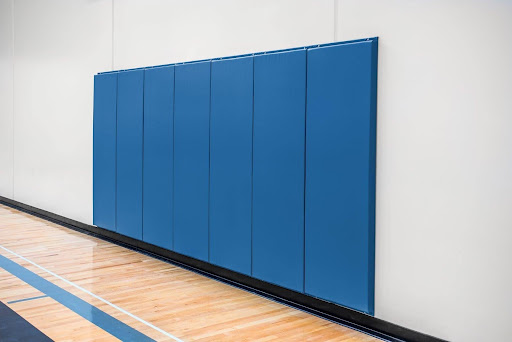
Walk the edge of an indoor court before looking at the playing surface. The greatest impact risks often sit just beyond the boundary line: columns, low walls, stage fronts, equipment stores, door frames and fixed seating. Players moving at speed focus on the ball and other people, not on the hard object approaching behind them. A useful safety review therefore starts with the run-off area.
Map where contact is most likely. Basketball players drive towards the baseline, volleyball players chase balls beyond the court, and indoor footballers change direction sharply near side boundaries. Training drills may use different routes from formal games. Observing real sessions reveals repeated movement paths, crowded corners and places where athletes lose balance. A review conducted only while the hall is empty misses those patterns.
Distance remains the first control. Where practical, moving play away from a hard feature gives athletes more time to stop. Relocating stored equipment, benches or portable goals may remove hazards without adding anything to the wall. Clear boundary markings and sensible station placement also reduce avoidable traffic close to fixed objects.
Wall padding becomes relevant when an unavoidable hard feature sits within a likely contact zone. Its purpose is to reduce the severity of an impact, not to make collision safe. The selected system should suit the location, expected type of contact and users. Height, width, firmness and coverage all need consideration, because a narrow padded strip may leave the main risk exposed.
Gaps and edges deserve close attention. A player may strike the join between panels, the unprotected section beside a door, or the hard surface just above the protected area. Padding must not introduce projections, loose corners or trip points. Any fixing method should keep the system secure during repeated use while allowing inspection and maintenance.
The court layout changes the risk picture. Retractable seating, divider curtains and portable apparatus create different boundaries from one session to the next. Staff should review each setup rather than relying on a single permanent plan. When a hall switches from a lesson to a competition, extra officials, team benches and spectators may narrow the available run-off space.
Condition checks should form part of opening the facility. Staff need to notice torn covers, exposed fasteners, compressed material, movement away from the wall or moisture damage. Wall padding that looks present but no longer sits securely may fail to provide the intended protection. Defects should be recorded and managed through the venue’s normal maintenance process.
Cleaning methods also matter. Sports halls collect dust, sweat and marks, but unsuitable products may damage covers or seams. The maker’s instructions should guide cleaning and inspection. Where panels are removable, staff should ensure they return to the correct position and remain firmly attached after access or building work.
Padding works alongside behaviour and supervision. Coaches should design drills with enough stopping space, control the number of athletes in each zone and prevent bags or bottles from collecting near boundaries. Players also need clear instructions about retrieving loose balls and entering active areas. These steps reduce exposure before any impact happens. They also help keep emergency access and officials’ routes clear.
Facility managers should revisit the risk map after changes. A new scoreboard, storage unit, doorway alteration or court marking may shift movement towards a different surface. Incident and near-miss reports provide useful evidence because they show where actual behaviour differs from the original design.
No protective product removes every consequence of speed, height or contact. Decisions should reflect the sport, age group, level of play and building layout, with suitable professional advice where needed. Local standards and organisational policies should also be checked rather than assumed.
The strongest approach works from the court outwards. Provide space first, remove movable hazards, control activity and protect unavoidable hard features. When wall padding is selected and maintained as one part of that sequence, the boundary becomes more forgiving without encouraging false confidence.










+ There are no comments
Add yours