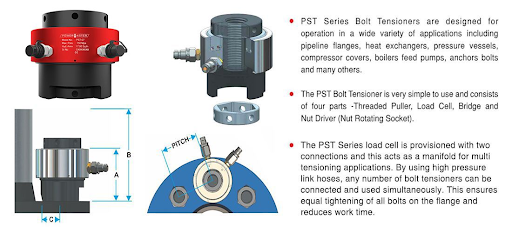
A multi stage bolt tensioner improves bolting accuracy in heavy-duty industries by using stacked hydraulic cylinders to stretch bolts axially, applying direct, uniform load without rotational friction. This eliminates torque-to-tension variables, ensuring exact clamp loads across tight-clearance, high-load critical joint connections.
Delve through this guide to learn the mechanics behind direct axial stretching, key joint integrity comparisons, and actionable industry applications.
Why Direct Axial Stretching Beats Friction-Based Tightening
Traditional torquing methods turn a nut against joint surfaces, losing up to 90% of applied energy to friction. This creates massive variance in actual bolt load.
A multi stage bolt tensioner overcomes this by pulling the bolt upward using hydraulic pressure. Once the exact pre-calculated load stretches the bolt, the nut is seated effortlessly by hand or socket.
Advantages of Multi-Stage Architecture
- Higher Load in Smaller Footprints: Stacking multiple hydraulic pistons vertically multiplies output force without increasing the tool’s outer diameter.
- Zero Torsional Stress: Bolts experience no twisting forces, preserving thread life and preventing stud shearing under extreme load cycles.
- Uniform Gasket Compression: Simultaneous multi-bolt tensioning prevents uneven flange crushing and costly fluid leaks.
Technical Comparison: Bolting Technologies
| Feature | Multi Stage Bolt Tensioner | Electric Torque Wrenches | Standard Torque Tools |
| Primary Force Method | Direct axial stretch (tension) | Rotational force (torque) | Rotational force (torque) |
| Friction Loss Impact | Negligible | Moderate to High | High |
| Load Accuracy | High | Good | Fair |
| Spatial Profile | Slim / Narrow radial clearance | Medium footprint | Large footprint |
| Ideal Application | High-load, tight pitch joints | Production-speed torquing | General maintenance |
While electric torque wrenches offer outstanding speed and programmable torque limits for general assembly, critical high-stress applications require tensioners to bypass friction completely.
How Multi-Stage Tensioners Solve Critical Industrial Challenges
Heavy-duty environments such as wind energy, oil & gas, and heavy manufacturing cannot afford bolt relaxation or joint leakage.
1. Eliminating Radial Space Constraints
Studs of large diameter need very high clamping forces. In single-stage hydraulic cylinders, the diameter needs to be increased to provide increased clamping forces, which often run into interference with the surrounding bolts or cylinder walls. Multi-stage hydraulic cylinders increase the height of cylinders instead of increasing their diameter.
2. Preventing Joint Relaxation and Failure
With individual tightening of all the bolts on a flange, tightening a single bolt results in a change in the load applied on the neighboring bolts (crosstalk). With tensioning, operation can take place simultaneously in 25% to 100% of the joint studs.
Key Takeaways for Equipment Engineers
Integrating advanced tensioning tools protects high-value infrastructure from catastrophic joint failure.
- Select for Space: Use multi-stage tensioners when radial clearance is limited but load demands remain high.
- Combine Technologies: Pair tensioning on critical load joints with electric torque wrenches for rapid assembly of non-critical support structures.
- Prioritize Accuracy: Direct axial load management significantly reduces long-term maintenance costs and unexpected operational downtime.
Using a multi stage bolt tensioner ensures precise structural integrity where conventional torquing falls short
Final Thoughts
The importance of accurate bolt loading cannot be understated while considering the prevention of any kind of failures, leakage, and expensive machine shutdowns in the heavy duty industry. Employing the use of a multi-stage bolt tensioner makes sure that there are no issues with friction, providing excellent clamping precision in close clearance high loading environments. Using other tools such as electric torque wrenches for regular assembly will lead to maximum performance from the joint.










+ There are no comments
Add yours